
These materials include correspondence and pamphlets related to circular orders and regulations in force at the Carlisle Indian School under Superintendent Moses Friedman. Friedman forwarded the documents to the Commissioner of Indian Affairs for approval. The forwarded documents include a blank Pupil's Health Report, the Outline of Course for…
School Farms - Animals and Livestock
July 19 - August 2, 1911
Format:
Books and Pamphlets, Letters/Correspondence
Topics:
Repository:
National Archives and Records Administration
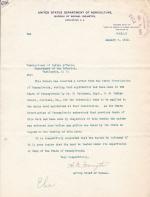
January 8-16, 1913
Acting Chief of the Bureau of Animal Industry A. M. Farrington asks if the Bureau of Indian Affairs would like the Carlisle Indian School's cattle herd tested for tuberculosis.
Second Assistant Commissioner of Indian Affairs C. F. Hauke informs Chief of the Bureau A. D. Melvin that he would like an inspector from his department to test…
Format:
Letters/Correspondence
Repository:
National Archives and Records Administration
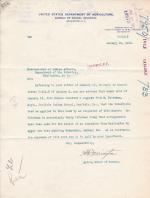
January 18-25, 1913
Superintendent Moses Friedman asks the Chief of the Bureau of Animal Industry to send a veterinarian to inspect Carlisle's dairy herd, noting that they built a new dairy barn based on his suggestions. Acting Chief A. M. Farrington orders an inspector to test the herd.
Format:
Letters/Correspondence
Repository:
National Archives and Records Administration
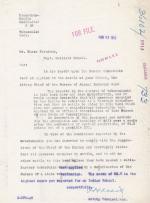
March 18-31, 1913
Acting Chief of the Bureau of Animal Industry A. M. Farrington informs the Commissioner of Indian Affairs that they tested the cattle herd at the Carlisle Indian School for tuberculosis in January, 1913. Of 46 total cows, 34 were healthy. The remaining 12 were slaughtered in Harrisburg and postmortem examination confirmed the test results that…
Format:
Letters/Correspondence
Repository:
National Archives and Records Administration
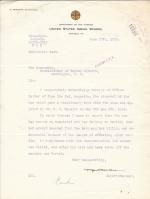
May 17 - July 1, 1913
Chief of the Bureau of Animal Industry A. D. Melvin informs the Commissioner of Indian Affairs that Dr. F. C. Bigelow tested four cows for tuberculosis at the Carlisle Indian School and found one to be infected. Melvin requests that the infected animal be slaughtered in Harrisburg.
Acting Commissioner C. F. Hauke orders Superintendent…
Format:
Letters/Correspondence
Repository:
National Archives and Records Administration
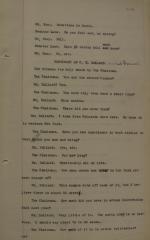
February 7, 1914
The typed transcript of C. K. Ballard's testimony before the Joint Commission to Investigate Indian Affairs. At the time Ballard was the assistant farmer at the school.
In his testimony Ballard answers questions about his role as second farmer and his opinions about what crops would be most productive on the land he works.
In the…
Format:
Legal and Government Documents
Topics:
Repository:
National Archives and Records Administration
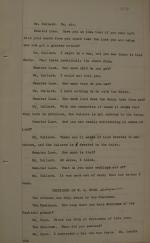
February 7, 1914
The typed transcript of W. J. Ryan's testimony before the Joint Commission to Investigate Indian Affairs. At the time Ryan was the dairyman for the school.
In his testimony Ryan answers questions about his role as dairyman (including number of cows in his care and the structures he uses) and describes difficulties with the male students…
Format:
Legal and Government Documents
Topics:
Repository:
National Archives and Records Administration
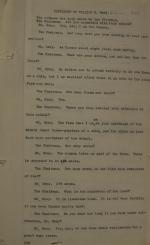
February 7, 1914
The typed transcript of William B. Gray's testimony before the Joint Commission to Investigate Indian Affairs. At the time Gray was working as a farmer at the school.
In his testimony Gray answers questions about his work on one of the farms that served Carlisle at the time. He discusses what is grown on the farm, students' role in the…
Format:
Legal and Government Documents
Topics:
Repository:
National Archives and Records Administration
June 24-29, 1914
Supervisor Oscar H. Lipps informs the Commissioner of Indian Affairs that he sold dried bones and old iron to Jacob Shields and asks the Commissioner which account to report the sale under. Second Assistant Commissioner C. F. Hauke informs Lipps to report the sale under "misc. Receipts, Class IV."
Format:
Letters/Correspondence
Standard Forms & Transactions:
Repository:
National Archives and Records Administration
March 19, 1915 - May 12, 1915
Supervisor in Charge of the Carlisle Indian School Oscar H. Lipps requests to sell two old cows because they no longer give milk. Second Assistant Commissioner of Indian Affairs C. F. Hauke grants Lipps permission.
Lipps later states that he sold a third cow and requests approval for this action. Assistant Commissioner E. B. Meritt…
Format:
Letters/Correspondence
Standard Forms & Transactions:
Repository:
National Archives and Records Administration
January 22 - February 7, 1916
Chief of the Bureau of Animal Industry A. D. Melvin informs Commissioner of Indian Affairs Cato Sells that when Dr. F. I. Winant tested Carlisle's cattle herd for tuberculosis in January of 1916, 34 were found to be healthy and 2 were found to be "suspicious."
Sells tells Carlisle Superintendent Oscar H. Lipps to slaughter the 7 infected…
Format:
Letters/Correspondence
Standard Forms & Transactions:
Repository:
National Archives and Records Administration
February 7- December 31, 1916
These materials include correspondence, ledger pages, inspection reports, and government forms regarding multiple health topics connected to the Carlisle Indian School. Included is an Inspection Report of H. B. Peairs for February 1916, Physician's Semiannual Reports for the first and second halves of 1916, statistical reports of diseases for…
Format:
Ledgers, Legal and Government Documents, Letters/Correspondence, Reports
Topics:
Student Illness, Inspection of the School, Discipline - General, Buildings and Grounds - General Descriptions, Athletic Program Administration, School Library, Student Nursing Training, Industrial Training - General, School Farms - Animals and Livestock, Outing Program – Overview/Statistics/Success of, Student Living Conditions
Standard Forms & Transactions:
Repository:
National Archives and Records Administration
February 7 - August 26, 1916
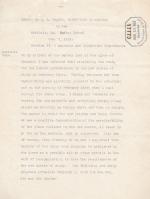
Supervisor of Schools H. B. Peairs' report on the Academic and Industrial Departments at Carlisle focuses on methods of instruction (i.e. too much written work), attendance, industrial department trades, outings of trade students, agriculture, domestic departments (cooking, sewing, laundering, home training and nursing), religious organizations…
Format:
Letters/Correspondence, Reports
Topics:
Standard Forms & Transactions:
Repository:
National Archives and Records Administration
May 5, 1916 - May 20, 1916
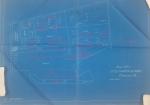
Carlisle Indian School Agriculture Teacher Leo Marks forwards maps or blueprints of both school farms and provides an inventory of the school's livestock. Commissioner of Indian Affairs Cato Sells thanks Marks' for his maps, inventory, and his farming knowledge.
Format:
Blueprints/Architectural Drawings, Letters/Correspondence, Maps
Repository:
National Archives and Records Administration
July 26 - August 2, 1917
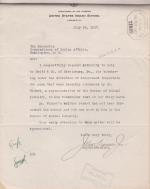
Carlisle Indian School Superintendent John Francis Jr. requests to sell two cows to Swift & Co. in Harrisburg. The cows were recently condemned by Bureau of Animal Industry Representative Dr. Winant during the tubercular test. Assistant Commissioner of Indian Affairs E. B. Meritt grants permission.
Format:
Letters/Correspondence
Standard Forms & Transactions:
Repository:
National Archives and Records Administration
May 1, 1918
This material includes the May 1918 inspection of the Carlisle Indian School by W. S. Coleman. The included correspondence between Commissioner of Indian Affairs Cato Sells and Coleman discusses the health conditions of outing students and the general campus, conditions at the school farm, and school athletics.
Format:
Letters/Correspondence, Reports
Topics:
Standard Forms & Transactions:
Repository:
National Archives and Records Administration