
Richard Henry Pratt provides statistics related to the industrial departments including the sewing room, tailor shop, shoe shop, tin shop, harness shop, blacksmith and carriage shop, printing office, and the laundry over the previous twelve months.
Printing Department
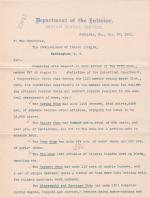
April 27, 1901
Format:
Letters/Correspondence
Topics:
Repository:
National Archives and Records Administration
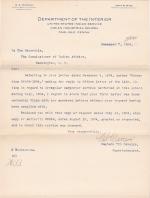
July 11, 1904 - November 7, 1904
William A. Mercer responds to an Office of Indian Affairs letter regarding the use of irregular carpenter services. Mercer provides the Office with the original request along with the authority granting the request.
Format:
Letters/Correspondence
Topics:
Standard Forms & Transactions:
Repository:
National Archives and Records Administration
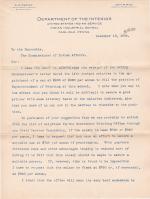
December 15, 1904
William A. Mercer responds to an Office of Indian Affairs regarding the vacancy in the Superintendent of Printing position. Mercer notes that he is willing to increase the salary if the Office is only able to secure an appointment through the higher salary.
Format:
Letters/Correspondence
Repository:
National Archives and Records Administration
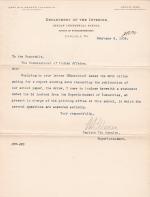
February 2, 1905 - February 8, 1905
Report of W. G. Thompson on the Printing Department of the Carlisle Indian School providing information asked by the Office of Indian Affairs.
Format:
Letters/Correspondence
Repository:
National Archives and Records Administration
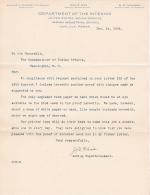
November 14, 1905
J. R. Wise provides the second proof of the circular requested by the Office of Indian Affairs and discusses the type of paper which can be used. Wise ends by noting that the printing department students were happy to know that the office was pleased by their work.
Format:
Letters/Correspondence
Topics:
Repository:
National Archives and Records Administration
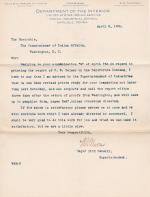
April 9, 1906
William A. Mercer informs the Office of Indian Affairs that the printing department at the Carlisle Indian School can have revised proofs ready shortly for the report of C. E. Kelsey on the California Indians. In addition, the department can complete and mail the report within three days.
Format:
Letters/Correspondence
Topics:
Repository:
National Archives and Records Administration
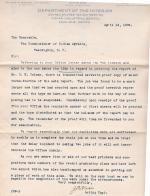
April 14, 1906
J. R. Wise forwards a proof copy of approximately three-quarters of the C. E. Kelsey report due to the size of the report. Wise notes that following the receipt of the proof the first sheets will be printed and the rest of the report will be set up for examination.
Format:
Letters/Correspondence
Topics:
Repository:
National Archives and Records Administration
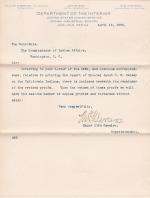
April 19, 1906
William A. Mercer forwards to the Office of Indian Affairs the remainder of the revised proofs for the report of C. E. Kelsey. Mercer notes that upon the return of the proofs the school will distribute the copies and forwarded.
Format:
Letters/Correspondence
Topics:
Repository:
National Archives and Records Administration
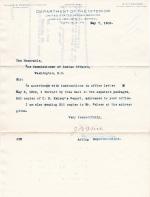
May 7, 1906
J. R. Wise informs the Office of Indian Affairs that he has forwarded 300 copies of C. E. Kelsey to the office and 200 copies to Kelsey.
Format:
Letters/Correspondence
Topics:
Repository:
National Archives and Records Administration
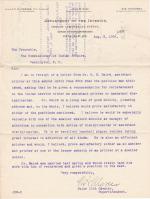
August 3, 1906
William A. Mercer informs the Office of Indian Service that Genus Baird has requested his assistance in being reinstated in the Indian Service. Mercer provides further information on the Baird.
Format:
Letters/Correspondence
Topics:
Repository:
National Archives and Records Administration
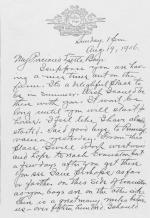
August 19, 1906
The father of Matthew and Wendell Jones describes his visit to the Carlisle Indian School. He discusses the games many of the students played as well as the work that was being done on the school grounds.
Also included is a letter from the widow of Wendell Jones noting that she had made a copy of the letter in 1988.
Format:
Letters/Correspondence
Topics:
Repository:
Cumberland County Historical Society
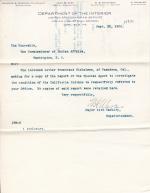
September 14, 1906 - September 22, 1906
William A. Mercer forwards a letter from Grace Nicholson requesting C. E. Kelsey's report on California Indians printed at the Carlisle Indian School.
Format:
Letters/Correspondence
Topics:
Repository:
National Archives and Records Administration
January 28, 1907
J. R. Wise responds to an Office of Indian Affairs letter regarding the Jamestown Exposition. Wise provides a list of articles to be provided by the Carlisle Indian School as well as building the exhibition cases. In addition, Wise states that the Johnston photographs can be used along with newer photos along with Native work from Angel De Cora…
Format:
Letters/Correspondence
Topics:
Repository:
National Archives and Records Administration
March 6, 1907
William A. Mercer further responds to the report of W. S. Olive regarding work done on Coach Glenn "Pop" Warner's car as well as various funds not officially accounted for by requesting authority for expenditures.
Format:
Letters/Correspondence
Topics:
Repository:
National Archives and Records Administration
March 26, 1907
William A. Mercer responds to the Office of Indian Affairs proposal for overseeing various funds at the Carlisle Indian School. He further requests that relative to the Printery Fund that he be allowed to expend $100 without prior approval.
An Office memo states that this proposal is satisfactory but that he should be required to submit…
Format:
Letters/Correspondence
Repository:
National Archives and Records Administration
April 16, 1907
William A. Mercer informs the Office of Indian Affairs newly produced photographs taken by students at the Carlisle Indian School along with items from the printing department for the exhibit at the Jamestown Exposition have been forwarded to their Office.
Format:
Letters/Correspondence
Topics:
Repository:
National Archives and Records Administration
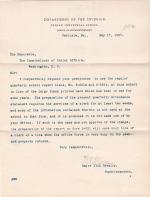
May 17, 1907
William A. Mercer requests authority to use the regular quarterly school report blank rather than the large blank printed at the Carlisle Indian School.
Format:
Letters/Correspondence
Repository:
National Archives and Records Administration
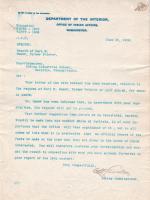
June 2-25, 1907
Former printer Karl H. Baker asks for the annual leave that he believes he was due before his dismissal/resignation from the Carlisle Indian School. Superintendent Moses Friedman states that Baker has several unpaid debts to Carlisle Indian School employees and to Carlisle businesses.
Furthermore, Friedman forwards clerk S. J. Nori's…
Format:
Financial Documents, Letters/Correspondence
Topics:
Standard Forms & Transactions:
Repository:
National Archives and Records Administration
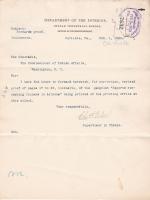
February 1-6, 1908
These materials include correspondence between the Superintendent of the Carlisle Indian School and the Commissioner of Indian Affairs regarding printing a pamphlet called "Reports Concerning Indians in Arizona."
Format:
Letters/Correspondence
Topics:
Repository:
National Archives and Records Administration
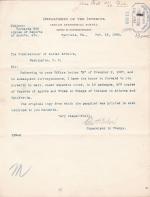
February 19-21, 1908
Correspondence between Superintendent of the Carlisle Indian School and the Commissioner of Indian Affairs regarding mailing pamphlets called Reports of Agents and Others in Charge of Indians in Arizona and California.
Format:
Letters/Correspondence
Topics:
Repository:
National Archives and Records Administration
December 29, 1908 - September 26, 1910
These materials include correspondence regarding the Christmas festivities of 1908. The festivities included a lantern slide and moving picture film presentation of Hiawatha, various receptions, tree decorating, and entertainment.
Also included is a financial authority request for extra food for the Thanksgiving and Christmas…
Format:
Financial Documents, Letters/Correspondence
Topics:
Repository:
National Archives and Records Administration
June 22-26, 1909
Carlisle Indian School Superintendent Moses Friedman informs the new Commissioner of Indian Affairs R. G. Valentine that he received the copies of the previous Commissioner Francis E. Leupp's resignation and will print and send back 100 copies. Friedman states that he is disappointed that Leupp had to resign due to poor health.
Friedman…
Format:
Letters/Correspondence
Topics:
Repository:
National Archives and Records Administration
July 31, 1909 - August 6, 1909
These materials include correspondence and a draft of Superintendent Friedman's 30th Annual Report for the Carlisle Indian School, reflecting the period ending July 31, 1909. Friedman forwarded the draft to a Bureau official, along with information on how to have news published in Carlisle's student newspaper. The annual report includes…
Format:
Financial Documents, Legal and Government Documents, Letters/Correspondence
Topics:
History of the Carlisle Indian School, Printing Department, BIA Policy and Policy Changes, Carlisle Indian School Policy and Policy Changes, Discipline - General, Student Illness, Industrial Training - General, Building Repairs and Expansions, School Farms - Statistics, Outing Program – Overview/Statistics/Success of, School Museum, Native Art and Industry Program, School Entertainment, Music Instruction, Enrollment Statistics, School Band Performances, Enrollment Policies
Standard Forms & Transactions:
Repository:
National Archives and Records Administration
August 20, 1909
J. H. Dortch provides Moses Friedman monthly reports in order to prepare the list of changes in Indian Service employees for publication in the Indian Craftsman. Dortch asks that once the list is compiled it be sent to the Office so that it can be reproduced elsewhere and that the reports should not be mutilated.
Format:
Letters/Correspondence
Topics:
Repository:
National Archives and Records Administration
March 4, 1910 - April 7, 1910
These materials include correspondence regarding an attempt to have the Red Man magazine classified as second-class mail. The eligibility of the publication for second-class designation was questioned, but an application was forwarded to the Bureau of Indian Affairs.
Format:
Letters/Correspondence
Topics:
Repository:
National Archives and Records Administration